logo

Thursday, January 26, 2012

Morning Market

Yesterday's market was really a tale of two markets, with the prices moving sideways under a little after lunch, and then rallying strongly for the remainder of the day.  The main cause was the Fed releasing it's statement that interest rates should stay very low for a few years.


The daily chart shows that prices are still rallying and are in an uptrend.  Also note that the MACD have given a further buy signal.


Yesterday, we say a strong pop in gold on extremely high volume.  Also note the bullish underlying technicals -- the MACD is rising, the shorter EMAs are rising, and the A/D and CMF show money flowing into the market.  The big reason for the move is the perception among investors that the Fed's policy will be long-term inflationary.


On the weekly chart, gold prices have broken through a longer-term resistance line.  


Industrial metals are in a strong rally now.  They've moved through all the EMAs and the shorter EMAs are rising.  We're seeing money flow into the market and the MACD is rising.  This is good, because


The dollar dropped sharply yesterday, and looks to be moving lower.  The reason for the sharpness of the drop was, again, the Fed's move.  This was a double, negative whammy for two reasons.  First, it implies a possible future inflationary environment, and second, it means interest rates will stay low for the foreseeable future.  Both outcomes are dollar negative.  The first scenario devalues the security and the second means that traders will not have a high interest rate when they purchase physical currency and park it in the US.

Greece To Lose Oil Supply II

A few days ago I asked where, with the implementation of EU sanctions on Iranian oil imports, will Greece, which currently imports 30% of its domestic oil from Iran on favourable terms, source its oil from?

I noted earlier this month that oil would likely rise to $150 a barrel, a price that would cripple the already enfeebled Greek economy.

Now it seems that IMF have woken up to this issue, and have warned that sanctions will cause a "large effect on prices".

The Telegraph quotes the IMF:

"A halt of Iran's exports to OECD economies without offset from other sources would likely trigger an initial oil price increase of around 20pc-30pc."

Brent crude is currently trading at over $110 per barrel, a rise of 30% gives a price of $143.

Greece Won't Play Major Role?

Reuters reports that Germany does not expect the troika of foreign lenders, that is currently in Athens, to deliver a report on Greece's progress before a summit of European Union leaders next Monday.

The German source that Reuters quoted then added that this meant that Greece would not play a major role at the EU leaders summit.

Who is he trying to kid?

Meanwhile, the Greek press is reporting that private lenders have accepted a lower interest rate in debt deal. Athens News Agency also says that PM Papademos and the IIF's Dallara are to meet at 8pm to resume debt swap talks.

My advice is, don't believe this rumour (especially given its source) because the ECB is not going to accept a loss.

Madness


David Cameron has told the Davos summit that to be even considering a Tobin tax is "madness".

Quite right!

Wednesday, January 25, 2012

1952: Inflation and Fed Policy

This posting is part of the Bonddad Economic History Project 


CPI was quite moderate.  The YOY percentage change started at 4% and slowly decreased throughout the year to a little under 1%.  Now, this type of deceleration can also be a sign of a potential recession on the horizon, which did start in the 3Q of 1953.


The YOY percentage change in PPI was negative for the entire year, indicating the input prices were dropping.


The above charts shows the absolute PPI level for the year, which shows the drop more completely.

As a result of the stable inflation picture, we see that the Fed did not raise rates in 1952. We also see that interest rates were fairly steady, with the exception of the continued upward movement of Treasury Bills, which jumped higher at the end of the year.  The Fed explained the increased as an increased demand for loans at the end of the year.


The above table shows the increase in various types of loans over the year.  Note the slow pace at the beginning of the year, while we see a big bump in the 4th quarter.  We see two reasons for the increase.  Business loans increased, with almost all of the increase coming in the fourth quarter.  In addition, "other loans to individuals" increased by $2.2 billion , but this increase came from a strong growth in the second, third and fourth quarters (for more on the increase in consumer credit, see the 1952; PCE post).


The above tables shows that corporate security issues rose strongly in 1952, and competed for commercially available capital.  The increase in 4th quarter lending was probably partially caused by an inability to complete an offering prior the end of the year.  Again, note the large increase in consumer credit.

In short, what we see here is a fairly stable financial system. 


Emerging Market/BRIC Currencies Breaking Out


Granted, they're breaking out from low levels, but they are breaking out.

Here's the Real Problem At the Federal Level


I've shows this graphic a few times in various forms, but it really deserves to be repeated.  At the federal level, we have two issues: low tax receipts and high spending.  As I've pointed out a few times, the big issue in the spending room is health care costs in the federal budget.  However, at some point, taxes are going to have to go up as well.

The above graph is from Econbrowser.


Rats Leaving The Sinking Ship

Unsurprisingly, given the failure to reach a deal on the Greek haircut, and the abrogation by the Greek government of responsibility for talking with bondholders (the Greeks have passed the buck to the Troika), hedge funds are now scrambling of offload Greek debt.

The New York Times reports:

"Hedge funds that in the past month or so have purchased an estimated 4 billion euros, or $5.2 billion, of beaten down Greek bonds that mature on March 20 are now trying to unload their positions, according to brokers and traders.

That is because it is becoming clear to one and all that Greece — under pressure from its financial backers — is preparing to impose a broad-based haircut that would hit all investors with a loss of 50 percent or more, whether they agree to the deal or not."

Meanwhile, private boindholders are meeting in Paris to determine their next course of action.

The ship is sinking fast, and not all the rats will escape in time!

George Soros Speaks

George Soros is making an opening speech at the Davos summit.

Faisal Islam quotes him:

"outlook is truly dismal. EU.. is undemocratic to the point where the electorate is disaffected and ungovernable."

That dear readers is why, in a nutshell, the Euro will fail!

Morning Market


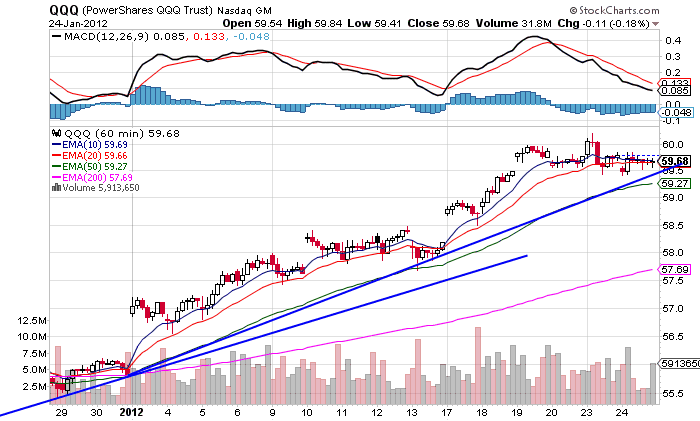
All three, 60 minute charts of the major equity averages show that prices are still in an uptrend. 


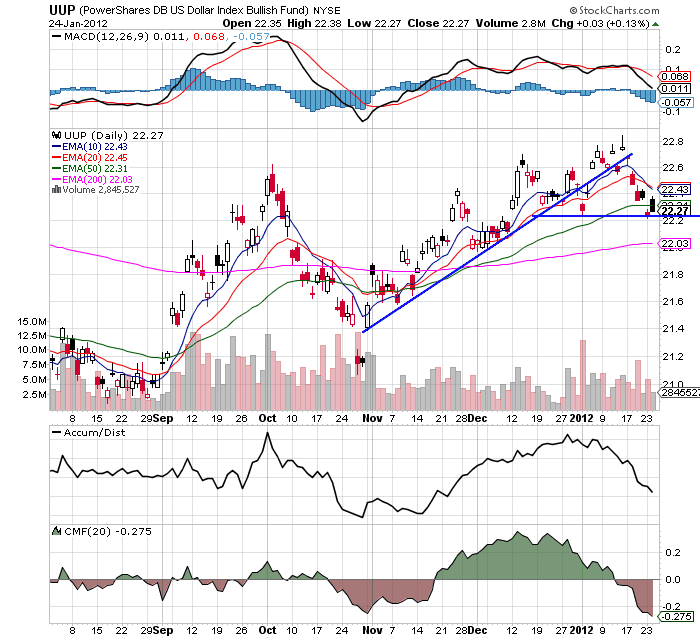
The dollar is a different story.  The top chart (a daily chart) show that prices have broken their uptrend and found support at lows established in early January.  In addition, the shorter EMAs are moving lower and the 50 day EMA is moving sideways.  The MACD has given a sell signal and the A/D and CMF show money is leaving the market.

On the lower, weekly chart, we see that prices have broken their upward trend line.  While the MACD is still positive, it is approaching a sell signal.  However, the trend break is the real story here.

This is a chink in the bullish market argument, as a rising dollar would be a sign of improved investor sentiment toward the US economy as a place to invest.  Some of this decline is due to the euro's recent risk (it has broken it's downward sloping channel patter).  However, I'm guessing there is also some second guessing occurring regarding the US economy's overall situation.


After breaking slight upward sloping trend lines, the IEFs an TLTs are hitting support established over the last few months.  Prices need to make moves through these support levels to give the bulls added upside momentum.

Right now, it appears we're seeing a bit of upward hesitancy.  This is to be expected, given that last week we saw prices move through important technical levels.  However, a pause can quickly turn into a reversal with the right fundamental change, so we definitely need to keep our eyes open.

Share

Twitter Delicious Facebook Digg Stumbleupon Favorites More