logo

Friday, May 20, 2011

You Are Here

This is the excerpt from the latest Fed Minutes about the current position of the economy:

The information reviewed at the April 26–27 meeting indicated, on balance, that economic activity expanded at a moderate pace in recent months, and labor market conditions continued to improve gradually. Headline consumer price inflation was boosted by large increases in food and energy prices, but measures of underlying inflation were still subdued and longer-run inflation expectations remained stable.

Private nonfarm payroll employment increased again in March, and the gains in hiring for the first quarter as a whole were somewhat above the pace seen in the fourth quarter. A number of indicators of job openings and hiring plans improved in February and March. Although initial claims for unemployment insurance were flat, on net, from early March through the middle of April, they remained lower than earlier in the year. The unemployment rate edged down further to 8.8 percent in March, while the labor force participation rate was unchanged. However, both long-duration unemployment and the share of workers employed part time for economic reasons were still very high.

Industrial production in the manufacturing sector expanded at a robust pace in February and March. The manufacturing capacity utilization rate moved up further, though it continued to be a good bit lower than its longer-run average. Most forward-looking indicators of industrial activity, such as the new orders indexes in the national and regional manufacturing surveys, remained at levels consistent with solid gains in production in the near term. However, motor vehicle assemblies were expected to step down in the second quarter from their level in March, reflecting emerging shortages of specialized components imported from Japan.

The rise in consumer spending appeared to have slowed to a moderate rate in the first quarter from the stronger pace posted in the fourth quarter of last year. Total real personal consumption expenditures picked up in February after being about unchanged in January. Nominal retail sales, excluding purchases at motor vehicles and parts outlets, posted a sizable gain in March, but sales of new light motor vehicles declined somewhat. Real disposable income edged down in February following an increase in January that reflected the temporary reduction in payroll taxes. In addition, consumer sentiment declined noticeably in March and remained relatively downbeat in early April.

Activity in the housing market remained very weak, as the large overhang of foreclosed and distressed properties continued to restrain new construction. Starts and permits of new single-family homes inched down, on net, in February and March, and they have been essentially flat since around the middle of last year. Demand for housing also continued to be depressed. Sales of new and existing homes moved lower, on net, in February and March, while measures of home prices slid further in February.

Real business investment in equipment and software (E&S) appeared to have increased more robustly in the first quarter than in the fourth quarter of last year. Nominal shipments of nondefense capital goods rose in February and March, and businesses' purchases of new vehicles trended higher. New orders of nondefense capital goods continued to run ahead of shipments in February and March, and this expanding backlog of unfilled orders pointed to further increases in shipments in subsequent months. In addition, survey measures of business conditions and sentiment in recent months were consistent with continued robust gains in E&S spending. In contrast, business outlays for nonresidential construction remained extremely weak in February, restrained by high vacancy rates, low prices for office and commercial properties, and tight credit conditions for commercial real estate lending.

Real nonfarm inventory investment appeared to have moved up to a moderate pace in the first quarter after slowing sharply in the preceding quarter. Motor vehicle inventories were drawn down more slowly in the first quarter than in the fourth quarter, while data through February suggested that the pace of stockbuilding outside of motor vehicles had picked up a bit. Book-value inventory-to-sales ratios in February were in line with their pre-recession norms, and survey data in March provided little evidence that businesses perceived that their inventories were too high.

The available data on government spending indicated that real federal purchases fell in the first quarter, led by a reduction in defense outlays. Real expenditures by state and local governments also appeared to have declined, as outlays for construction projects decreased further in February to a level well below that in the fourth quarter, and state and local employment continued to contract in March.

The U.S. international trade deficit narrowed slightly in February after widening sharply in January. Following a solid increase in January, exports fell back some in February, with declines widespread across categories. Imports also declined in February after posting large gains in January. On average, the trade deficit in January and February was wider than in the fourth quarter.

Overall U.S. consumer price inflation moved up further in February and March, as increases in the prices of energy and food commodities continued to be passed through to the retail level. More recently, survey data through the middle of April pointed to additional increases in retail gasoline prices, while increases in the prices of food commodities appeared to have moderated somewhat. Excluding food and energy, core consumer price inflation remained relatively subdued. Although core consumer price inflation over the first three months of the year stepped up somewhat, the 12-month change in the core consumer price index through March was essentially the same as it was a year earlier. Near-term inflation expectations from the Thomson Reuters/University of Michigan Surveys of Consumers remained elevated in early April. But longer-term inflation expectations moved down in early April--reversing their uptick in March--and stayed within the range that has prevailed over the past several years.

Available measures of labor compensation suggested that wage increases continued to be restrained by the presence of a large margin of slack in the labor market. Average hourly earnings for all employees were flat in March, and their average rate of increase over the preceding 12 months remained low.

The pace of recovery abroad appeared to have strengthened earlier this year, but the disaster in Japan raised uncertainties about foreign activity in the near term. In the euro area, production expanded at a solid pace, though indicators of consumer spending weakened. While measures of economic activity in Germany posted strong gains, economic conditions in Greece and Portugal deteriorated further. The damage caused by the earthquake and tsunami in Japan appeared to be sharply curtailing Japanese economic activity and posed concerns about disruptions to supply chains and production in other economies. Emerging market economies (EMEs) continued to expand rapidly. Rising prices of oil and other commodities boosted inflation in foreign economies. However, core inflation remained subdued in most of the advanced foreign economies, and inflation in the EMEs seemed to have declined as food price inflation slowed.

The Two Current Economic Issues

After reading a large amount of data, there appear to be two economic issues domestically that are indicators of the slowdown.

1.) Manufacturing. We're seeing one month slowdown readings from a variety of regional Fed indexes. We've seen weaker readings from Dallas, Richmond and Kansas City. This month, we've seen drops in Philadelphia and New York's readings. These readings are confirmed by the latest industrial production number from the Federal Reserve, which took a big hit from auto production decreases caused by Japan's earthquake.

2.) Initial unemployment claims: these spiked to very uncomfortable levels over the last few weeks, but have since dropped back to just over 400,000. We've heard continually that the increase was caused by one-time, seasonal factors. The latest drop adds some credibility to these thesis, but we're still not out of the woods.

I mention these points, because the latest leading indicators dropped by .3, with the drop caused by lower readings from a majority of the sectors.

Right now the incoming date continues to be mixed; the caution flag is still waving.

Sex

It seems that successful men are driven by many demons, that would appear to be the conclusion to be drawn from the public downfalls of Sir Fred "the Shred" Goodwin (ex head of RBS) and Dominique Strausss-Kahn (ex head of the IMF).

Sir Fred had in place, until yesterday, a "super injunction" that forbade the mention of him even being a banker. However, following disclosures made in the House of Lords yesterday about his affair with a senior colleague, the terms of the injunction were varied. Mr Justice Tugendhat, sitting at the High Court, varied the injunction to allow reporting of Sir Fred's name, but not details of the alleged relationship or the name of the colleague said to be involved.

As to why the affair is so important rests not with the affair itself per se, but the fact that RBS has a code of conduct that would have required Sir Fred to tell the board of the affair, lest there be a conflict of interest.

It is not yet clear as to whether he told the board, or whether the affair itself may have distracted him during a critical time in the bank's operations.

The FSA has been asked to investigate. However, given the mess that they have made so far wrt their last investigation (yet to be reported) into the collapse of RBS, any FSA investigation is likely to produce nothing of any value.

In other news, quite by coincidence, the IMF has published its code of conduct (which cover "personal relationships").

Human beings, no matter how successful, all share one common characteristic; we are all very flawed.

Thursday, May 19, 2011

Friday Dollar Analysis

Two weeks ago, I wrote the following about the dollar:

The dollar may be in a position for a technical rebound. Last week there was very little action lower, with prices instead moving in a rounding pattern. There has been a large volume spike over the last week, which may be the sign of a selling climax. Also note the gap higher today and the very strong candle print. There was a strong fundamental reason for the change of direction: dovish statements from the ECB regarding interest rates. I'm suspecting that some of today's action was also some short covering.

.....

The idea of a rebound trade does not mean that the fundamental downward trend that is in place is in any danger of being broken. Prices have still moved through important long-term support levels indicating a strong move lower is already taking place. What is happening is a simple "profit taking" of the shorts. Given the underlying interest rate and fundamental issues underlying each currency, I don't see any reason to the dollar is in danger of a strong rally at this point. But, if you're shorting the market, I would consider taking some profits off the table right now.

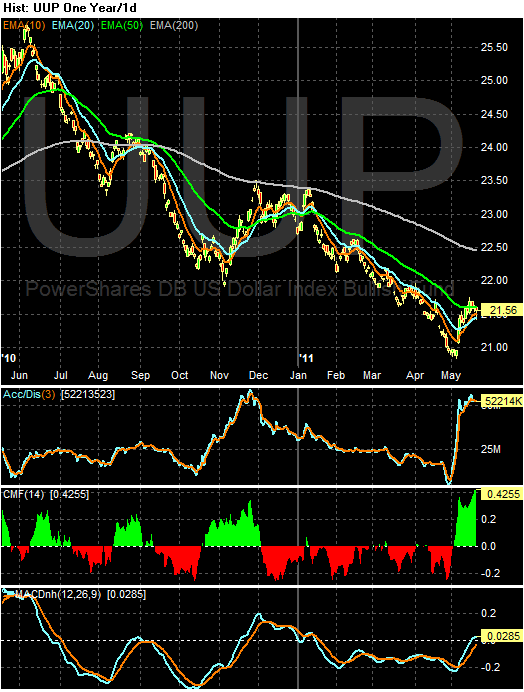
Then blogger went down, so I didn't post anything last week. Let's take a look at the chart to see what has transpired since then.


Basically, I felt the chart indicated we would see a technical trade with the dollar bouncing higher, but little change to the overall, underlying trend. So far, that is what has happened. The dollar caught a safety bid as concern over the EU situation made the dollar a more attractive asset. Prices have bounced up and hit resistance at the 50 day EMA and have moved a touch lower since.

The EMAs are sending the following signal. The shorter EMAs (the 10 and 20) are moving higher and the 10 has moved through the 20. Also note the 50 day EMA is now moving sideways. There is a fair chance we will see one of the shorter EMAs cross the 50 over the next few weeks. These are preliminary signals of a change, but one that is not confirmed yet.

However, take note of the longer trend:


The longer trend is still lower; the recent bump is (so far) a blip in the longer trend.

My general feeling about the dollar is the following:

Right now, we're in the middle of a technical bounce higher so far has not disrupted the overall trend. A strong move above the 50 day EMA over the next week or so will change that. In addition, if we see important technical crossings (the 10 or 20 moving over the 50) a re-evaluation will be necessary as well. However, if you played the technical bounce, I'd take money off the table now and wait to see how the market plays out. Ultimately, I'd still be looking for a longer shorting opportunity.

It's a long g****m tunnel

- by New Deal democrat

I realize I'm supposed to be a happy-talking, recovery-cheerleading, corporate shill, but I see no reason whatsoever to disagree with Atrios, this morning:
There are so many economic data releases, and they're all a bit noisy, so you can see good or bad news if you want. Still I think a reasonable distillation of it all is that even if the light at the end of the tunnel is just around the corner - though it may not be - it's a long goddamn tunnel. The unemployment rate is too damn high.
My biggest concern is that jobs and real household income will not even make it back to their pre-great-recession levels before the next one hits.

P.S.: Of course, Bonddad let the cat out of the bag this morning. We're really just econo-dorks.

My Favorite Blogs

We originally posted this last Thursday. But then blogger went down and we lost the post. As such, we're reposting this because there are some people who both NDD and I feel should be getting a wider readership and we would like to do our part to get it to them.

I don't think I've ever done this -- write a blog about what blogs we read on a regular basis. But I read a ton (which is one of the reasons I became a lawyer) so it seems appropriate to mention the blogs/analysts whose work I read on a regular basis as a grand hat tip.

Economists View: Professor Thoma posts a large amount of very thought provoking information on all things economic. More importantly, he does not post a few paragraphs, instead adding longer pieces that provide a fair amount of substance to a topic. I should also add he has been very helpful in making recommendations about economic books to read on certain areas.

DeLong: First -- he's a prolific writer, so there is almost always something of interest. But most importantly, he's one of the few economic writers who has actually read most economic thought (Say, Keynes, Mill etc..). In other words, he is pretty much the only person on the web who understands most of the arguments been advanced by all sides. At minimum this provides a great service to the web, but it also goes to show that there is a dearth of this type of understanding within the economics community. Finally -- fs there a topic that Brad DeLong does not know something about?

Carpe Diem: Dr. Perry posts some very pertinent fact based information regarding the economy. Ever the optimist, it's frankly good to have someone on the web who does see the good news that is around us (and yes, there is some). I should add -- there are times when he zooms into zombie like political commentary which I skip over.

Tim Duy's Fed Watch: I first learned about this site from Mark Thoma's site. Duy provides some great insight into what the Fed's public statements indicate about its internal thinking process. This is very informative, as I simply don't have the time to read all the public statements from the various Fed offices and presidents. Duy's writing is always sharp and very well organized.

StreetLight: Kash also posts at Angry Bear. Kash writes some of the best commentary on the web. His writing is lucid; his explanations clear. His recent analysis regarding the strength of US manufacturing was particularly good, although his work in general is top notch.

Afraid to Trade: Corey is without a doubt one of the best technical analysts on the web today. He never over plays his hand, but carefully weighs the chart data in a very even handed and fair manner. Additionally, he's a really nice guy who deserves all of his success.

Slope of Hope: Tim knight was one of the people (or perhaps the only person) behind the website Prophet.net -- which was literally the best technical website on the web. After he (or they) sold Prophet, he opened up this website. Tim posts charts and very good market analysis, along with individual trade ideas.

EconLog: I don't get the Libertarian perspective at all. But these guys explain it well. Their writing is clear and concise, beautifully organized and well-presented.

Sites to avoid: anything political that tries to write on economics. Just as an example from both sides of the aisle; the idiots at Powerline still argue that Thomas Sowell should be awarded a Presidential medal -- even though Sowell still argues for the application of Say's law despite this little event called the Great Depression making that argument more than moot. Daily Kos is dominated by the perma bear mentality which has completely missed the successful rebound of US manufacturing (which has accounted for about half of the growth during this recovery) and the recovery in its entirely.

Russ Winter is a another data hound, who has written some very good articles on China over the last about 6 months. He went behind a data wall a little bit ago, but has (thankfully) re-emerged.

A Dash of Insight -- run by Jeff Miller -- is another great site. First -- we thought we were the nerdiest blog on the net. Miller is very data driven and does a remarkable job of stripping out personal and political bias in his analysis. He is also very even-handed as he goes through the data, presenting a remarkable fresh view of the economy and the markets.

I'm adding this in a rush, so

Matt Trivisono

Dshort

Modeled Behavior

The Japan Effect

Consider the following chart from Dr. Ed Yardini's blog:

And consider these effects from the WSJ:


  • U.S. auto production slowed in April. “For the first time in 10 months U.S. manufacturing output fell in April, on account of a fall in auto production as the natural disaster in Japan disrupted the supply of auto parts,” the global macro team at the World Bank reports in its daily digest of economic news. “The disruptions to the auto sector are expected to linger through the second quarter thus continuing to dampen the contribution of that sector to overall industrial production growth in the US through the second quarter.”
  • Singapore’s non-oil domestic exports in April were down 1.8% compared with a year earlier, compared with a 9.9% increase in March. “Exports appear to be facing headwinds from the supply-chain disruptions associated with the calamities and, likely also, the impact of elevated oil prices on disposable incomes in advanced economies,“ said Leif Eskesen, India and Asean economist at HSBC. “Going ahead, we are likely to see more soft readings over the next few months for the same reasons, although the Japan-related supply disruptions are expected to be temporary and dissipate during the second half of 2011.”
  • Of course, the effects are strongest closest to home: Japan reported Thursday its economy shrank in the first quarter at a seasonally adjusted annualized rate of 3.7%. Two consecutive quarters of economic contraction is the shorthand definition of a recession. “The further contraction in GDP in Q1 confirms that Japan is now in recession and we expect the decline in Q2 to be even bigger,” says Capital Economics. “The economy was weak before the Great East Japan Earthquake struck on 11th March and the full impact of that catastrophe has only just begun to be reflected in the GDP data.”

Expect these effects to continue through as least the end of the second quarter, and probably well into the third.

Ma Demission

Dominique Strauss-Kahn has tendered his resignation (in French) to the IMF.

John Lipsky, formerly Strauss-Kahn's deputy, is acting managing director.

A permanent successor will be chosen by the executive board later this year.

Let us trust that his replacement will not be Gordon Brown!

Wednesday, May 18, 2011

Thursday Oil Market Analysis

Last week I wrote the following about the oil market:

The 5-minute page shows the drop, the rally along a slightly upward trend line and then yesterday's move through the trend.

Yesterday I mentioned that I am now a bit cautious on commodities. The reason is there is now evidence that some of the faster growing economics (Brazil and India) are slowing down. China's inflation rate is now higher than desired, indicating the PBOC will continue raising rates. And gas demand in the US is dropping as a result of lower prices.

At the same time, we're not crashing, just slowing. While the US economy printed a slow 1Q, there are no signs of a double dip. As such, I still see a very tight supply/demand situation.

Right now, I have no read on the oil market and would avoid it; there are simply too many wildcards in the mix currently.


Let's take a look at the current daily chart to see if new information is available.


The chart shows the very sharp drop-off, but also shows a consolidation pattern. There is support in the 96-97 area. There is also a possible triangle consolidation pattern emerging. But I'm personally no comfortable with that analysis, thinking a sideways, rectangle consolidation with a top at the 104 handle is possible. In addition, the EMAs are printing a bearish picture: all are moving lower and the shorter are below the longer. For now, I think this takes the wind out of a consolidating triangle with prices moving higher argument.

So, a move below 96 is a good shorting opportunity. I would wait to go long at levels above 104; there is simply too much traffic below that level to get through to go long before that point.

Link

The Great Untold Manufacturing Success Story

Consider this chart from Kash over at the Streetlight Blog:


Manufacturing has been a very bright spot for the economy during this recovery. However, it has largely gone unnoticed for two reasons. The political left is wedded to the idea that "US manufacturing is dead" while the political right doesn't want to point out any success story in the economy.

Yet, here we are, with manufacturing doing very well.

Share

Twitter Delicious Facebook Digg Stumbleupon Favorites More