logo

Monday, October 25, 2010

More Growth Ahead?


From Bloomberg:

Copper for delivery in December added 7.8 cents, or 2.1 percent, to $3.875 a pound at 8:30 a.m. on the Comex in New York. Prices touched $3.8895, the highest level since July 2008. Copper for delivery in three months climbed 2.2 percent to $8,515 a metric ton on the London Metal Exchange. All of the six main metals traded on the LME gained.

.....

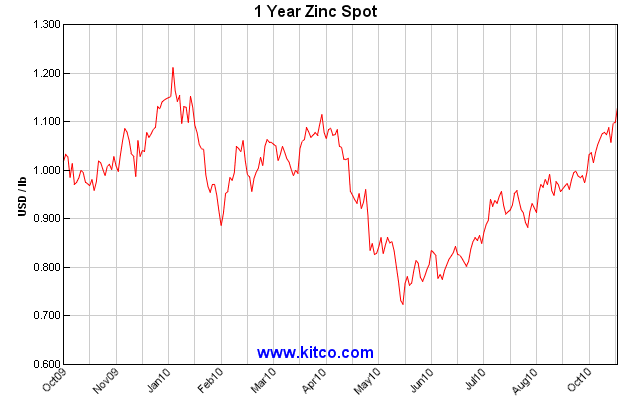
Zinc and lead for three-month delivery on the LME both touched $2,600 a ton, the highest price for each since Jan. 11. Shenzhen Zhongjin Lingnan Nonfemet Co., China’s third-largest zinc producer, shut its main zinc and lead smelter as of Oct. 21 after breaches of environmental rules.

“The lead and zinc smelter closure is way overdone, but being used as a convenient excuse for their strength,” RBC’s Heath said. “Both lead and zinc had lagged behind the likes of copper, nickel and tin because their short- to medium-term fundamentals had not matched those of their peers. As result, they are now outperforming and playing catch-up as some of the investment ‘value’ trades are unwound.”

Zinc rose 2.6 percent to $2,577 a ton and lead added 1.8 percent to $2,576 a ton.

Aluminum gained 1.1 percent to $2,391 a ton on concern colder temperatures in China, the world’s largest producer, will worsen power cuts to energy-intensive industries including Aluminum Corp. of China Ltd.

Part of this rise is a reaction to the US' interest rate policy; as the dollar drops, commodities prices in dollars become cheaper. However, some of this is also demand driven, especially from Asia.

Consider the following charts from Kitco:


Food Price and Inflation


From Agrimoney.com:

Indeed, many Chinese crops set new records on Monday, including cotton, which soared 5.0% on the Zhengzhou to the maximum allowed by exchange limits, hitting a fresh record of 26,270 yuan a tonne for the benchmark May lot.

In New York, December cotton soared by more than 4% to 124.71 cents a pound, a fresh record in that exchange too.

.....

Corn too hit a record high of 2,250 yuan ($338) a tonne on China's Dalian exchange, with farmers reported to be holding back sales amid reports that the country's harvest has not been nearly as productive as the 169m tonnes that official have forecast.

In Chicago, that erased concerns lodged by last week's data showing US weekly exports at their lowest for six years. Indeed, it raised the prospect of China returning to buy American corn.

.....

In soybeans, also a key Chinese purchase, prices were a little more restrained on the Dalian, up 2%, and less stratospheric in Chicago too, adding 1.7% to $12.19 ¼ a bushel for November delivery, returning 4 cents or so from setting a fresh 14-month high.

The oilseed, after stagnating a bit at the end of last week, appeared to have returned to good books among speculators who, according to latest regulatory data, taken up until last Tuesday, have kept adding to their positions.

"Speculators are a record net long 145,000 contracts after adding 5,000," Australia & New Zealand Bank said, adding that open interest, the number of active contracts in soybeans, was at a record high of 904,000 too.

High levels of speculative buying can be mixed blessing, signalling interest from fast money, but also the build up of a position which could, one day, be exited fast.

Starting with wheat a few months ago, we've seen some big spikes in agricultural prices. However, will this have an impact on CPI? Here are two charts, each of which is 10 years long. They cover the last 20 years and compare the year over year percentage change in crude foodstuffs and feedstuffs with overall CPI.


From 1989-1999 crude food and feedstuffs were quite volatile, but overall CPI was subdued.


The same can be said of the 1999 to the last CPI reading.

Both of these charts show the following.

1.) Food prices are extremely volatile, but also gyrate between positive and negative year over year growth fairly regularly.

2.) The bleed through to overall CPI is minimal. That means that producers are absorbing costs of the rise in raw materials and not passing on a lot of the increases to consumers.


The Beige Book, Part III; Lending


From the Beige Book:

Lending activity was stable at low levels across most Districts, but there were some reports that demand picked up slightly. The Richmond and Dallas District reports noted increased lending activity, and Chicago said credit conditions continued to improve in the District. Reports from Richmond and Dallas suggested that competition for quality loans had picked up. Some contacts noted there was pressure to price loans slightly more aggressively.

Demand for commercial and industrial loans remained weak as businesses continued to postpone capital spending plans because of economic and public policy uncertainties. However, merger and acquisition lending picked up in a few Districts. Commercial real estate lending remained subdued and loan standards were still tight.

On the consumer side, lending was sluggish, but there were scattered reports of improvement. Contacts in the Cleveland and Dallas Districts reported growth in auto loans. Residential mortgage lending and refinancing activity increased in several Districts, and San Francisco reported an increase in demand for nonconforming mortgage loans.

Credit quality changed little on balance. New York reported a decrease in delinquency rates on consumer loans, however, and overall quality improved in the Philadelphia and Richmond Districts, according to reports.

Before we look at the report, let's take a look at some of the macro data:


(note the chart is on a logarithmic scale) Commercial and industrial loans are decreasing, but note this is nothing abnormal for this part in the cycle. The severity of the drop during the last recession is a story, but notice that the bottom didn't drop out.


Notice the pace of C and I loan contraction is slowing.


Despite the bump up due to an accounting change, consumer lending is still down. However, also note this is not abnormal either.


Real estate lending has also dropped a bit, but this is a bit more abnormal from a historical perspective.

Let's take a look at the anecdotal information from the report:

NY: Small to medium-sized banks report that loan demand was generally steady overall: respondents indicate a moderate decrease in demand for consumer loans and commercial and industrial loans, but a moderate increase in demand for residential mortgages; demand for commercial mortgages was little changed. Bankers also note a continued increase in refinancing activity. Credit standards are reported to have tightened for commercial and industrial loans and mortgages, with no reports of easing standards in these categories; however, banks report little or no change in credit standards for consumer loans and residential mortgages. Bankers' responses suggest some decrease in spreads of loan rates over costs of funds for residential mortgages but no change in spreads in the other loan categories. Respondents indicate ongoing widespread decreases in the average deposit rate. Finally, bankers report a decrease in delinquency rates for consumer loans but little or no change for other loan categories. Separately, contacts at credit unions indicate that credit conditions and business activity generally remain steady.

Philly: Total outstanding loan volume at most of the Third District banks contacted for this report has been level since the last Beige Book. Commercial bank lending officers said there has been virtually no change in any credit category. Bankers continued to report slack demand for both consumer and business loans. "Business loan demand is incredibly weak," one said. Another banker said, "Credit line usage is well below normal." With low demand for credit, some bankers reported increased competition among lenders, especially for business loans. Commercial bank officers indicated that credit quality has continued to improve as borrowers work down debt.

The consensus outlook among the Third District bankers surveyed for this report is that there will be minimal growth in lending until both consumers and businesses regain confidence that the economy is improving. Several bankers said that in recent discussions with their commercial customers, both business owners and managers said they are postponing expansion and other capital spending programs until current political and economic uncertainties are resolved.

Cleveland: The business-lending environment remains soft; however, almost half of the bankers we spoke with noted that demand showed some signs of a pickup across industries. On the consumer side, conventional loan demand remains very weak, with most of the activity found in indirect auto lending and home equity lines of credit. Interest rates for business and consumer credit moved by only a few basis points, with a slight bias to the downside, as competitive pressures are growing. Most of our contacts said that the demand for residential mortgage refinancing is very strong, while new-purchase mortgage originations remain at a slow pace. Residential mortgage rates continued their downward trend. Core deposits increased at almost all banks, with most of the growth occurring in nonmaturing products. Credit quality was generally characterized as either stable or deteriorating, while most reports on delinquencies indicated rates were stable or showed a modest decline. Several bankers noted that they have slowly increased their payrolls during the past few months.

Richmond: Lending activity around the District improved slightly, according to most bank contacts. Several bankers reported that the volume of new mortgage loans increased slightly in September, although one banking executive noted that most home loans went to people moving into the area. New mortgage activity at a major regional bank in the District, however, was reported as flat in recent weeks. Most bankers said that the bulk of mortgage lending was for refinancing, and one loan officer noted that refinancing activity stopped abruptly whenever the smallest uptick in mortgage rates occurred. Industrial loans were up slightly for equipment as well as inventory, according to one lender, while another banker reported very little commercial real estate lending. Several bankers stated that the competition among banks for quality loans was increasing. An officer reported that his bank had lowered rates to recapture auto dealer floor plan loans that had been lost to larger, more aggressive banks. An increase in merger and acquisition activity was widely reported. Several bankers cited examples of companies with strong balance sheets that were buying weaker competitors. Most bank officials reported improved credit quality, with a decline in both the number of foreclosures and late payments.

Atlanta: District banking conditions remained weak as bank profitability continued to be challenged by elevated loan losses and high levels of noncurrent loans. Loan demand also remained soft. Business contacts continued to indicate an expansion of trade credit to create and extend lines of credit outside of the traditional banking infrastructure.

Chicago: Credit conditions continued to gradually improve in September. Contacts indicated that the corporate financing environment remains very favorable, but the availability of credit for small businesses remained a source of concern for some. Business loan demand was steady, driven mostly by refinancing and merger and acquisition activity. Recent tax law changes and increasing pressure from shareholders to productively employ the large amounts of cash on firm balance sheets were seen as contributing to the latter. Furthermore, a contact noted that private equity funds that are required to invest funds by year-end or return them to investors were another likely factor. Investment demand for distressed commercial properties remained strong. Moreover, limited improvement in the availability of bank loans for commercial real estate was noted, although it was concentrated among a few banks.

St. Louis: Total loans outstanding at a sample of small and mid-sized District banks decreased 1.8 percent in the three-month period from mid-June to mid-September. Real estate lending, which accounts for 73.2 percent of total loans, decreased 2.2 percent. Commercial and industrial loans, accounting for 16.1 percent of total loans, decreased 1.6 percent. Loans to individuals, accounting for 5.1 percent of loans, decreased 7.9 percent. All other loans decreased 8.5 percent and accounted for 5.6 percent of total loans. Over this period, total deposits increased 0.3 percent.

KC: Bankers reported steady loan demand, stable deposits, and an unchanged outlook for loan quality. Consistent with the last several reports, overall loan demand was little changed. Demand edged up for commercial and industrial loans and residential real estate loans but decreased for consumer installment loans. Demand for commercial real estate loans was stable. Credit standards were unchanged in all major loan categories, after tightening modestly on commercial real estate loans in the last two reports. Somewhat more bankers reported deterioration in loan quality from one year ago than reported an improvement. However, for the fourth straight report, respondents expected no change in loan quality over the next six months. Deposits were basically flat, continuing the pattern since late last year.

Dallas: Financial firms reported some pickup in lending activity. Consumer loan demand rose substantially, in large part due to growth in auto loans. Home mortgage activity picked up slightly as well. Despite high mortgage delinquencies contacts said they are not concerned with outstanding credit quality overall. Financial contacts noted increased pressure to price loans more aggressively and some have even begun altering loan structure somewhat, although overall underwriting standards remain very strict. Larger banks are reportedly seeing stronger loan demand than regional and community banks. There were reports of smaller banks passing up good owner-occupied real estate deals because of stricter enforcement of regulatory guidelines on commercial real estate.

Friso: Reports from District banking contacts indicated that loan demand was largely unchanged compared with the prior reporting period. Demand for commercial and industrial loans continued to be restrained by businesses' cautious approach to capital spending and desire to deleverage. Consumer loan demand also remained weak overall, although contacts noted an uptick in demand for nonconforming mortgage loans. While lending standards stayed relatively restrictive for business and consumer lending, the reports suggested some loosening of credit standards for select groups of borrowers. Contacts also pointed to an uptick in financing for corporate acquisitions as well as further modest expansion in IPO activity.

Here are some observations, in no order of importance:

  • Several districts (Richmond and Chicago) reported an increase in M and A activity.
  • Several districts reported an increase in competition for loans among lenders
  • Refis are the primary activity in the residential market right now
  • Dallas reported an increase in auto loans for consumers. This is the second part of the report that has shown an increase in auto purchases
  • Chicago noted an increase in demand for distressed commercial properties. I think this is a fairly big untold story of the CRE market right now.
  • Loan demand appears to have picked-up slightly, although the report overall still indicates the overall lending environment is very weak.


Push for Growth

As David Cameron at the CBI promises that the government will push for growth and implement a national infrastructure plan (whatever that really means), these promises need to be set against the backdrop of a subdued mortgage/loan market.

The British Bankers' Association (BBA) reports that the downward trend in mortgage approvals continued in September, along with a low demand for personal loans.

The BBA attribute this to personal economic uncertainties.

Fair comment, however, they should also look to their own members' tightening of credit lines (and extortionate interest rates when compared to the Bank of England rate) as another reason for the fall in lending.

Whatever "push for growth" the government may promise/aspire to, the strength of the British economy is based on debt/property; until these areas are stimulated, eg via greater bank lending, significant growth will not occur during the course of this parliament.

Yesterday's Market

As the three charts below show, there was little movement in the equity, bond or dollar market on Friday. Treasuries tried to rally about resistance in the AM (a), but quickly fell back into a quiet and narrow trading range.


Notice the technicals for the dollar are indicating a turnaround is in order: the A/D line is rising, the CMF is positive and the MACD has given a buy signal. However, consider this against the fundamental background with the Fed indicating they will be buying Treasuries, engaging in QEII. Is this really an environment where we'll see a meaningful change of trend, or will the "rally" really be an opportunity to find a short entry point? The answer is most likely the latter.

Let's take a look at the three major equity averages -- the QQQQs, the SPYs, and the IWMs:


Over the last rally, the QQQQs and IWMs -- the riskier areas of the market -- have been outperforming the SPYs.


Cotton is still in a strong upswing. The chart has a "fanning" set of lines -- a set of continually escalating trend lines, pointing to a higher and higher rally. Also note the EMAs are bullishly alighted and the MACD is in clear buy territory.

Friday, October 22, 2010

Weekend Weimar and Beagle

It's that time of the week. Don't think about the economy or the market for the next few days. We'll be back on Monday AM.

Until then.....


Weekly Indicators: Indian Summer Edition

- by New Deal democrat

This week's column comes with a seasonally appropriate soundtrack that you can enjoy while you read the stats:


Monthly statistics this week included the LEI for September up .3 as expected, but August was revised down to +.1. This means an economy remaining just barely positive going forward. Meanwhile housing starts and permits moved in opposite directions, starts showing strength and permits weakness. Industrial production and capacity utilization both declined, the former down -.2%, showing the coincident economy in a stall. The Philly Fed index was also barely positive. One piece of good news was the American Institute of Architects index showing expansion for the first time in over two years, adding to the data suggesting that commercial construction will bottom out sometime next year.

Let's turn now to the high frequency weekly data. For the first time in over a month, this past week most were soft.

The Mortgage Bankers' Association reported that its Refinance Index increased 11.2% from the previous week, losing about 1/2 of the gain from the week before. Refinancing is still proceeding at a fast clip in response to near record low 15 and 30 year mortgage rates. The seasonally adjusted Purchase Index, however, decreased again by 6.7% from one week before, the second steep slide in a row. The purchase index is back near July's lows. This is probably in response to mortgage qualification standards that were tightened earlier this month but is a point of concern.

The ICSC reported same store sales for the week ending October 3 declined -0.7% week over week, and were up only 1.7% YoY, the weakest comparison in many months. Shoppertrak did not make a report again this week.

Gas prices rose 1 cent to $2.83 a gallon, and at usage at 8.891 million gallons was slightly below last year's 8.950. Gasoline stocks increased again, and continue to be 10% above their normal range for this time of year. Oil retreated to $81 a barrel, still near the upper end of its 6 month range.

The BLS reported 450,000 new claims, but last week's 463,000 new jobless claims were revised significantly upward to 475,000. The continually elevated layoffs has been the single most depressing weekly statistic all year. The four week average stands at 458,000.

Railfax continued to baseline and intermodal rail traffic improving last week. Economically sensitive waste and scrap metal improved still is running no better than last year's levels. This means there is trend growth but no higher.

The American Staffing Association reported that for the week ending October 19, temporary and contract employment declined very slightly -.21% but the ASA says the overall index remained at 100.0, equalling its two year high.

M1 declined 1% last week, but was up 0.6% 1month over month, and up about 5.5% YoY, so “real M1” is up 4.4%. M2 increased less than 0.1% last week, +0.7% month over month, and up 3.2% YoY, so “real M2” is up 2.1%. "Real" M2 remains close to breaking out of the "red zone" of +2.5%, which would give us the "all clear" as to any "double dip."

Weekly BAA commercial bond rates increased 0.15% last week to 5.74%. This compares with yields on 10 year bonds up +.05%. A smidgen of risk aversion entered the bond market this week.

Thirteen days into October, the Daily Treasury Statement is up $97.7 B vs. $84.8 B a year ago, a gain of over 15%! For the last 20 days, receipts are up $132.7 B vs. $116.9 B a year ago, a gain of about 13%.


Manufacturing in particular looks to be stalling, and there was some weakness carried over into same store sales, but nothing that qualifies as concern of a double-dip at this point. Purchase mortgage applications will be important to watch next week.

Have a nice weekend!

A Closer Look At Gold


Gold is still in a strong uptrend (A). Along the way, prices have consolidated in downward sloping pennant patterns (B, C and D) -- all standard trading developments. However, notice the 10 day EMA is now moving lower (E) and the MACD has given a sell signal. Also note that prices are now through the 10 and 20 day EMA In short, this is beginning to look like a correction.

The Beige Book, Part II: Manufacturing

From the Beige Book:

Manufacturing activity continued to expand, with production and new orders rising across most Districts.
.....
Manufacturing activity continued to expand, and several Districts reported gains in production or new orders across a wide range of industries. The only exceptions were the Philadelphia and Richmond Districts, where activity softened compared with the previous reporting period. Exports boosted manufacturing activity according to contacts in the Cleveland, Chicago, and Kansas City Districts. Producers of semiconductors and other high-tech equipment saw continued growth in sales in the Boston, Dallas, and San Francisco Districts. Auto production rose strongly in the Cleveland and Chicago Districts. Metals producers in the Chicago District reported that September sales were the strongest year-to-date, while contacts in the Minneapolis, Dallas, and San Francisco Districts saw only modest gains. Shipments of steel in the Cleveland District continued to be buoyed by demand from energy-related, automotive, and heavy equipment industries. Food processors in the Philadelphia and Dallas Districts noted solid demand for their products, while a few contacts in the St. Louis and Minneapolis Districts reported plans to expand existing operations.


The overall tone of the overview is better than expected: manufacturing was expanding; sales are growing; auto production was up strongly, solid demand existed for food processors, St. Louis and Minneapolis are looking to expand operations. This is in contrast to the latest industrial production report which showed a contraction of .2%.

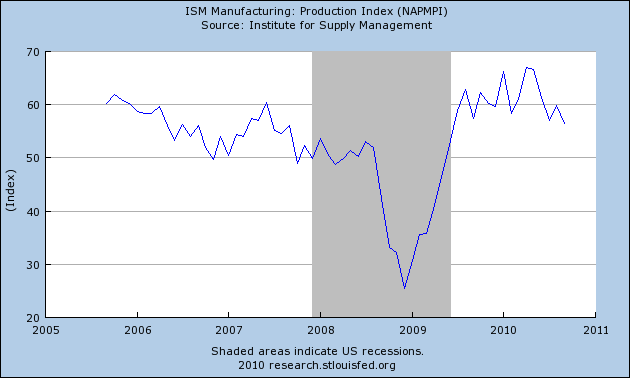
Let's take a look at several parts of the ISM manufacturing numbers:


The overall index peaked near the 60 level a few months ago and has fallen to the 55 area. However, that is still an area of expansion according to the index.


The overall production index is also at high levels and has been there for some time.


However, the new orders index is near 50 and has dropped sharply over the last few months. While the number is still expansionary, it is very close to a recessionary reading.


New exports are also at strong levels. While their overall level has dropped over the last few months, they're still at decent levels.

I covered a fair amount of this information a few weeks ago in this post. However, since then, we've had two key reports from the East Coast -- the area of the country that was experiencing the worst of the manufacturing slowdown. The Empire State index showed improvement:

The general business conditions index climbed 12 points to 15.7, a clear gain over the relatively low but positive readings seen from July through September. This month, 35 percent of respondents—roughly the same share as in September—reported that conditions had improved over the month, while 20 percent reported that conditions had worsened, a significantly lower percentage than last month. The new orders index moved up 9 points, to 12.9. After turning negative in August and September, the shipments index rose above zero, climbing 20 points to 19.4. The unfilled orders index rose for a third consecutive month, but remained just below zero at -1.7. The delivery time index advanced several points, but also remained negative, suggesting that delivery times continued to shorten. The inventories index turned negative, falling 13 points to -11.7, its lowest level since January, indicating that inventory levels declined over the past month.


However, the Philly Fed continued to show weakness:

The Mid-Atlantic manufacturing sector continues to sputter. The Philly Fed's new order index, at minus 5.0 in October, continues to show month-to-month contraction though at a slightly slower rate than September's minus 8.1 or August's minus 7.1. Contraction in backlog orders is steady, at minus 8.9 vs. the prior months' minus 8.5 and minus 7.1 before that.

Lightness in the pipeline makes manufacturers nervous about inventories. Manufacturing inventories in the region, in contrast to the nation, are coming down fast, at minus 18.6 in October following minus 16.7 in August and minus 11.6 in July. Manufacturers continue to report a lack of pricing power for finished goods with the prices received index down around the 12 level the last three months. Shipments are steady and employment has edged higher the past two months. Yet the decline in orders doesn't point to future gains for shipments or employment.

A positive not to be overlooked is sudden optimism in the six-month outlook where indications for new orders, shipments and employment all just about doubled in strength. The Mid-Atlantic region may be sagging yet the weakness may be isolated and may only be temporary.


Let's look at the information from the Fed Districts:

Boston: Nearly all contacted manufacturing firms report continued sales growth in the second half of the year after very strong first-half results. One semiconductor firm reports record sales and profitability in the third quarter and other firms selling into semiconductor-related markets also report robust growth. Some of this growth is fueled by strong demand overseas, but some is also coming domestically from the auto industry. Business also remains very strong at a technology services firm. However, a number of firms note that even as sales continue to increase on a year-over-year basis, demand has slowed relative to the first half of 2010. One firm, which manufactures products for the residential real estate market, attributes this deceleration to some of its customers destocking after buying in anticipation of second half demand that never fully materialized; this firm expects sluggish demand going forward. Overall sentiment amongst responding manufacturers is that demand will continue to be subdued for the rest of the year and into 2011, although few, if any, expect conditions to worsen.

NY: Manufacturing firms in the District report a pickup in activity in September, following a pause in July and August, and a growing proportion of manufacturing contacts indicate that they are increasing employment and plan to add more workers in the months ahead. (see also the link to the Empire State index above)

Philly: Third District manufacturers reported slight decreases in shipments and new orders from August to September, on balance, as well as a decrease in order backlogs. Despite the generally slower activity among the region's manufacturing industries, some sectors reported increases in demand for their products, notably makers of industrial machinery and equipment, producers of wood products, and food processers.

Cleveland: Reports from District factories showed that new orders and production rose modestly during the past six weeks. Production was also higher on a year-over-year basis, with many contacts experiencing double-digit increases. Several manufacturers commented that opportunities are growing faster in offshore markets than domestically. Almost all of our respondents expect business activity to follow current seasonal trends for the near term. Most steel producers and service centers reported that volume was either flat or trending up. Shipments are being driven by energy-related, auto, and heavy equipment industries. Two contacts noted that exports are gaining strength. All of our steel contacts expect little change in business activity in the near term. District auto production showed a large increase during August on a month-over-month basis, due to production starts on the 2011 models. In terms of year-over-year comparisons, production was little changed for both domestic and foreign nameplates.

Richmond: District manufacturing edged down in September after expanding for the last seven months, with reports of sharp declines that were partially offset by pockets of strength. Several textile and apparel contacts described their business as having "no depth" and noted that their customers expressed uncertainty about the direction of their business. A tire manufacturer reported that a backlog of orders had "tanked" and the company had cut production, noting that he did not expect any improvement for the rest of the year. A manufacturer of exterior doors for residential housing said that his firm had seen a sharp drop-off in orders and shipments over the last several months, with no indication that the trend might reverse. He anticipated that the housing and building products sector would be anemic in 2011. However, a furniture manufacturer reported an increase in orders and noted that his customers said that Labor Day sales were better than anticipated and held up throughout September. In addition, an auto parts supplier stated that orders remained strong and had increased slightly over the last month. Finally, our survey contacts reported that raw materials and finished goods prices, as well as wages, increased at a slower pace than in our last report.

Atlanta: District manufacturers indicated that the growth of new orders slowed notably and that production was flat in September compared to the previous month. However, many respondents planned modest production increases in the short-term.

Chicago: Manufacturing production increased in September, refreshing from the late summer pause. Several metals manufacturers reported that September sales were the best so far this year. Power generation, mining, and medical equipment manufacturers also reported an increase in orders. In addition, export activity continued to be robust with slower growth in developing countries in Asia and South America offset by strengthening demand from Europe. The automotive and heavy equipment sectors remained strong sources of growth. In contrast, a manufacturer of household appliances noted a reduction in fourth quarter production, and capacity utilization in the steel industry edged lower. Although contacts in some industries indicated that new orders and order backlogs had eased as inventory rebuilding slowed going into early October, manufacturers in general expressed a very positive outlook for the remainder of 2010 and early 2011.

St. Louis: Manufacturing activity has continued to increase since our previous report. Several manufacturers reported plans to open plants and expand operations in the near future, while a smaller number of contacts reported plans to close plants or reduce operations. Firms in the detergent, frozen foods, transformer, plastic products, motor vehicle parts, and primary metal manufacturing industries reported plans to expand existing operations and hire new employees. Contacts in the construction machinery, electronic component, and wood product manufacturing industries reported plans to open new facilities in the District as well as hire new employees. In contrast, firms in the appliance, tobacco, chemical, and furniture manufacturing industries announced plans to decrease operations and lay off workers.

Minneapolis: Manufacturing output was up since the last report. A September survey of purchasing managers by Creighton University (Omaha, Neb.) showed strong increases in manufacturing activity in Minnesota and South Dakota, and slight increases in North Dakota. In Montana, a food processing company is expanding operations and a jet engine plant plans to build a facility. In Minnesota, a fishing tackle company recently experienced a big pickup in demand, a metal fabricator saw increased orders, a dental part maker noted increased sales and a bed manufacturer's recent sales were up and higher than anticipated.

Kansas City: The Tenth District's manufacturing sector reported a mild rebound following softness in the prior reporting period. Factory operators reported expanded production, shipments, and new orders, and firms remained optimistic about future production levels. Despite increased activity, few firms reported planned increases in capital spending or hiring in the coming six months. The rebound in activity produced an increase in backlogs and raised expectations for future backlogs. Some improvement was reported in orders for export markets, though expectations for further expansion remained modest. Inventories of both raw materials and finished goods were reported as in balance with no planned changes from existing levels. The strength reported in manufacturing did not spillover to transportation firms as contacts noted unexpected weakness in activity. Some high-tech firms reported sales growth, but expectations for improvement in the coming two quarters were subdued. Capital spending activity by high-tech firms continued its upward trend but firms reported somewhat diminished expectations for the upcoming six months.

Dallas: Most construction-related producers, including cement, lumber and fabricated metals firms, said orders remained flat over the past six weeks. Contacts believe soft demand is related to uncertainty about the economic and political environment. One glass contact said sales rose due to a pickup in apartment construction. Primary metals producers noted a slight uptick in business. Some contacts are selling to new markets, such as solar panel production. Others indicated that remodeling activity had boosted sales. Despite the increase, contacts believe the industry has a long road ahead.

Manufacturers of high-tech products said that sales and orders were growing at the same or slightly slower pace since the last report. Most respondents said inventories are below or at desired levels. Sales are expected to continue to grow at a moderate pace over the next six months, but there was increased uncertainty in respondents' outlooks.

Paper manufactures said orders were slightly down, in part because customers were managing inventories more tightly. Contacts expect sales growth to be anemic through year-end. Food producers said demand growth held steady. Sales growth of premium items had picked up, but orders for value items weakened. Most transportation manufacturers noted steady demand.

Petrochemical producers noted strong domestic demand for most products. Export growth continued to slow, reflecting higher prices, although there were reports of renewed Chinese interest in some products. Domestic orders for PVC used in commercial construction were weak, but exports were stronger, according to contacts. Refiners said conditions continued to weaken. Both margins and operating rates fell since the last report, and gasoline and distillate inventories have risen against seasonal expectations.

Frisco: District manufacturing activity expanded further on balance during the reporting period of September through early October. For manufacturers of semiconductors and other technology products, demand continued to grow, although the pace of growth slowed a bit and inventories rose slightly. Extensive order backlogs continued to keep production rates at or near capacity limits for manufacturers of commercial aircraft and parts. Demand firmed further for metal fabricators, although capacity utilization remained well below normal. Activity at petroleum refineries slowed a bit and inventories rose, as seasonal declines in domestic demand were only partly offset by increased overseas demand. Conditions in the wood products industry remained depressed.


Some observations, in no order of importance:

-- Textiles and construction/housing related industries are hurting
-- High tech manufacturing is doing well
-- Oil is fair
-- Exports will continue to be a source of strength,
-- The overall manufacturing sector is not hitting on all cylinders; some areas are doing well, while others are treading water
-- Autos are a surprising source of strength
-- There appears to still be a fair amount of caution in the air about the future
-- The Richmond and Atlanta Districts are a pocket of weakness, probably due to their mix of manufacturing industries.
-- On balance, it seems there are more positive developments than negative. But, there is enough weakness for concern going forward.

More Quantitative Easing

Judging by signals from both the Chancellor and the MPC, the Bank of England is gearing up to increase its level of quantitative easing (currently around £200BN).

The Telegraph quotes George Osborne:

"The country needs a decisive plan, we've set out the decisive plan.

It has some caution built into it, there is of course the freedom for the Bank of England to deploy monetary policy tools as well
."

QE is where the government "prints" new money and uses it to purchase gilts, corporate bonds and commercial paper. Thus it ends up paying the interest owed on the government debt purchased to itself.

As and when the cuts cause excessive political problems, or simply do not work, the government (in the guise of the Bank of England) will print money.

Share

Twitter Delicious Facebook Digg Stumbleupon Favorites More