logo

Tuesday, September 27, 2011

Rumours Feed Markets - The End is Nigh

The European Investment Bank has stated the following today:

“There have been media reports about a potential involvement of the EIB in a special purpose vehicle in connection with the EFSF, for the purpose of bailouts.

The EIB has not been approached and has no plans to be involved in this.

The EIB will continue to focus on its mission which is financing viable investment projects."

Why did these rumours start, and what purpose do they serve?

Markets have rallied briefly, in time for the month end, useful for traders et al looking to show a "good" month.

Those who doubt EIB's rebuttal, re read the last sentence:


"The EIB will continue to focus on its mission which is financing viable investment projects."

No one on the planet can call Greece a viable investment.

In fact Valor Economic reports that Brazil is now preparing for a Greek default within the week.

"Something must happen. Greece is a few days [from bankruptcy]" said a high official source."

Looking At Another Fed Hawk's Argument

Last week I looked at Fed President Fisher's argument for not engaging in further Fed policy easing.  While part of his argument made sense (the Fed had already done all it could do) part of it did not (that regulatory burdens were hindering a hiring increase).  Today I want to look at Minneapolis Fed President Narayana Kocherlakota's argument for not engaging in further Fed policy easing.
Much of my discussion so far has been a look back over the past three and a half years, since the start of the Great Recession in December 2007. My assessment is that, despite some profound economic shocks, the FOMC—led by Chairman Bernanke—has successfully met its price stability mandate by engaging in imaginative forms of monetary accommodation and thereby helped lower the unemployment rate. Now I’d like to turn to my assessment of the most recent round of FOMC decision-making. To put this part of my talk in the proper context, I want to ask another key question: How did the FOMC achieve its success over the past three and a half years with regard to price stability?

The answer, I believe, is that the FOMC consistently made choices in response to changes in short-term economic conditions that were designed to support its medium-term objectives. Getting these choices right is certainly more of an art than a science. With that said, economists have suggested a number of rules that tell central banks how to respond to changes in economic conditions so as to keep inflation near some target level. I generally find these rules useful in guiding policymaking, and especially so when they arrive at the same recommendation. (Unfortunately, that’s not always the case.)

But here’s one instance in which most of the rules do deliver the same recommended course of action. Suppose the FOMC observes an increase in available measures of inflationary pressures and a decrease in labor market slack—that is, the gap between maximum employment and observed employment. Then many monetary policy rules would recommend that the FOMC not ease policy further and in fact consider reducing the level of monetary policy accommodation. That recommendation—don’t ease further if you’re doing better on your mandates—makes sense to me.
With that recommendation in mind, let’s go back to November 2010. At that date, the FOMC took a significant policy step by announcing its intention to buy $600 billion of longer-term Treasury securities. Until the most recent meeting in August, this was the last major policy step undertaken by the Committee. What did available measures of inflationary pressures and labor market slack—the “mandate dashboard”—look like back in November?

In terms of inflation, I generally think that core inflation does a better job of tracking underlying inflationary pressures, because it does not include the highly volatile and transitory fluctuations in food and energy prices. In November, PCE core inflation over the preceding 12 months had been less than 1 percent and had decelerated throughout the year. Of course, a good mandate dashboard should also include some measure of the future course of inflationary pressures. Here, it is worth noting that, even with the large-scale asset purchase in place, FOMC participants expected core inflation to remain very low: less than 1.3 percent over the upcoming calendar year of 2011.

In terms of labor market slack, I’ve argued elsewhere that it’s hard to find reliable measures of this key variable.8 But the FOMC statement makes specific reference to the unemployment rate as a gauge of labor market slack, and so I’ll use that measure on my notional mandate dashboard. The unemployment rate was 9.8 percent in November 2010. With the help of the large-scale asset purchase, FOMC participants expected it to fall to about 9 percent a year hence.
 Let's stop and take a more thorough look at the situation in 2010.   First, note there are two variables he's looking at: inflation (as expressed by the PCE core inflation number) and labor market slack (as defined by the unemployment rate).  At this time, inflation is running at less than 1.3% and unemployment is at 9.8%.  From his perspective, inflation is low and labor slack is high, so it's OK for the Fed to act.
How had the mandate dashboard changed in August 2011? PCE core inflation rose sharply: From December 2010 through July 2011, the annualized core PCE inflation rate was over 2 percent. FOMC participants did not submit forecasts of core PCE inflation in August. However, the most recent Survey of Professional Forecasters, done before the August FOMC meeting, predicted that core PCE inflation will average 1.7 percent in 2011 and 1.6 percent in 2012. It seems clear that inflationary pressures were higher in August than in November. My own current forecast for core PCE inflation is even higher than the SPF’s—I expect that it will average around 2 percent per year over 2011 and 2012.

What about labor market slack? The unemployment rate was 9.1 percent in August 2011, as opposed to 9.8 percent in November 2010. Again, we don’t have FOMC participant projections available from the August meeting. However, the Survey of Professional Forecasters predicts that unemployment will be 8.6 percent in just over a year’s time. Going into the August FOMC meeting, my own forecast for unemployment was a little more optimistic, in the sense that I do expect unemployment to be under 8.5 percent by the end of next year. But, even with the more pessimistic SPF forecast, labor market slack is smaller than in November 2010, when the FOMC expected unemployment to remain around 9 percent in a year’s time.

So, measures of past and forecasts of future inflationary pressures were higher in August than at the time of the FOMC’s last major policy move in November. Measures of current labor market slack and expectations of future labor market slack were smaller in August. The monetary policy rules that I described earlier would suggest, again, “Don’t ease further if you’re doing better on your mandates.” Indeed, they’d recommend that the level of policy accommodation be reduced.
Flash forward to the last meeting when core PCE was over 2% and unemployment had moved lower to 9.1% with further projected increases in PCEs and declines in unemployment over the next 6-12 months.  The question now becomes: is this an appropriately high level of inflation to be concerned about higher prices and a declining unemployment rate to think more can not be done?  As I've noted, inflation is running at hot levels, so I think this is a valid concern.  Most importantly, I'm concerned about food prices maintaining increased pressure on the CPI number.  However, arguing there is a sufficient drop in unemployment to indicate a decreasing of labor market slack is a non-starter -- especially considering the length of time of many of the unemployed.  Simply put, unemployment is still way too high to considering making this argument viable.  As such, I don't think it holds up as indicating slack in decreasing in a sufficient degree.

I will add that I think if he had stuck with inflation, and then pointed to overall CPI plus food prices (which are running very hot as noted at the above link) he would have been on sound ground. 


Morning Market


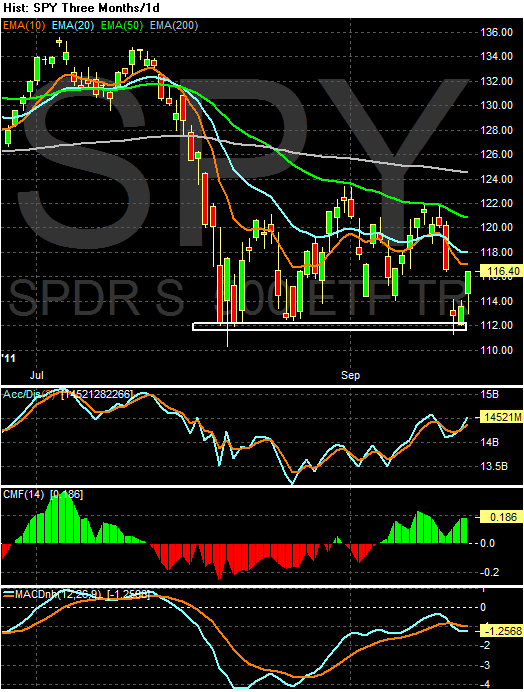
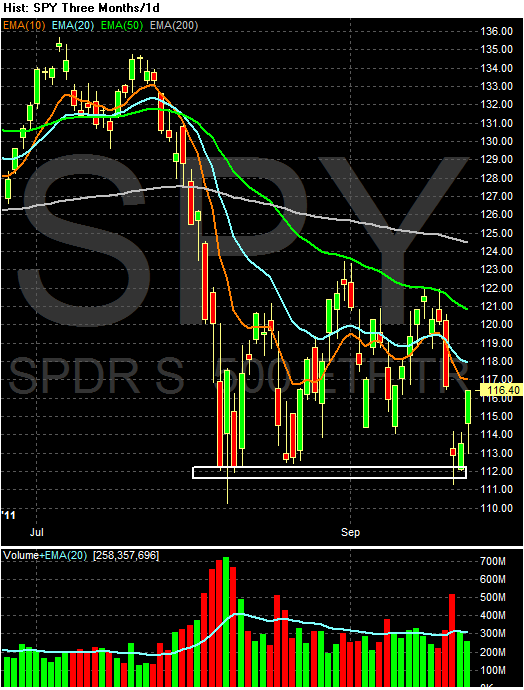
As Barry said yesterday, it's all about the bounce -- or, more specifically, the price action from the 112 are.  This is the third time prices have hit the 112 area.  In trading parlance, that means we really, really really need to see prices make a strong advance through the EMAs or we've probably got serious problems.  Yesterday's  bar was fairly strong, but it hit resistance at the 10 day EMA and printed on fairly weak volume.


The tehnicals are fair.  The A/D and CMF show money moving into the market, but the MACD is in negative territory and has given a sell signal.  Additionally, the overall macro environment is extremely bearish, meaning traders are more likely to sell into the rally than participate in it.


This is interesting -- despite the strong move in the dollar, we're not seeing a corresponding move in the A/D or CMF.  In fact, the overall A/D trend is down and the CMF is neutral at best.  In fact, despite the very important and strong technical move, we're seeing pretty weak technicals on the dollar, which makes me think the underlying rally is weaker than anticipated.


As with the dollar, the IEFs underlying technicals are also surprisingly weak.  The A/D line is moving horizontally, the CMF is decreasing as is the MACD.

The above technicals indicate we need to possibly rethink the following:

1.) The strength of the dollar rally.  Without an accompanying advance in the A/D and CMF, we're seeing shares advance on weak participation.  That means there isn't a lot of excitement to this rally.

2.) The strength of the Treasury rally, which indicates there has actually been a lack of participation as well.


A Dishonest Man

"Guarantee that Greece will live up to all its commitments."

Greek PM George Papandreou

Nonsense!

People are planning for a Greek default, the Greeks know it and everyone else knows it.

Greece will take the next tranche of bailout money, then default (as already planned by the EU and the Greeks).

For the reality, see my article posted a few minutes earlier (entitled An Honest Man)


An Honest Man - Alessio Rastani

Monday, September 26, 2011

Measuring the Oil choke collar

- by New Deal democrat

Recently I've begun measuring the impact of energy costs not just by the price of West Texas Intermediate Crude (WTIC) which closed last week just under $80 a barrel, but also by the price of gasoline at the pump. That's because there has been a unique but marked divergence between WTIC and Brent crude in the last 12 months.

Here's a graph showing WTIC (blue) and Brent (red) oil prices in barrels, compared with the price of gasoline at the pump (green, converting gallons into barrels for consistency):


Note the unusual divergence between the blue and red lines in the last year.

Now here is the same data, focusing on the last 7 years, and pricing gasoline in $ per gallon (right scale):


Now here are the peak prices this year and recent prices for Brent, WTIC, and
gas at the pump:

Brent: high $125.36 on 4/29, up 46% YoY
$114.98 on 9/16, off 9% from peak

WTIC: $112.30 4/29, up 33% YoY
$89.22 9/16, off 19% from peak

Gasoline: $3.96 on 5/9, up 34% YoY
$3.60 on 9/19, off 9% from peak

Gas at the pump has clearly been following Brent, not WTIC. Professor James Hamilton previously indicated a 50% YoY increase with the necessity of about $130 Oil to meet his criteria for an Oil shock recession. If we measure in Brent, as opposed to WTIC, we just barely missed those recession criteria.

It is important to note, however, that Professor Hamilton has advised that in his research, he has used the producer price index for crude petroleum, which averages the crudes by their importance to refiners. Further, he notes, if we go by this measure, we were still 7% off the 3-year peak at the end of 2011:Q1.

One of the first places we would expect an Oil shock to turn up is in sales of automobiles. In that regard, here are auto sales for the last 5 years:


Auto sales have indeed behaved as if there was an Oil shock induced reduction of demand beginning in May of this year. Because of the supply chain effects of the tsunami in Japan, we cannot know how much of the fall-off in demand was due to that vs. a reflection of high gasoline prices.

The decline in consumer purchases of durable goods in the last few months has been an important part of the weakening economy. With the effects of the tsunami wearing off, September auto sales reported next week will assume an added importance. Via Calculated Risk and the LA Times, for the first half of the month, sales were encouraging.
How to Think About the Dollar

From this week's Barron's
So why should the U.S. dollar appreciate in such a horrid environment? As the world's reserve currency, Taylor says, the dollar has become a reverse indicator of the globe's economic health. "Whenever things are good in the world, [the] currency goes down," since there's ample liquidity. But when the rest of the globe is doing poorly, there's no liquidity and therefore the U.S. dollar is worth more. "That is the most important thing to know about foreign exchange nowadays–it is kind of backwards," he says.

Distract The People With a Small War

Greek Prime Minister George Papandreou called for calm over Cyprus in a phone conversation with Turkish Prime Minister Tayyip Erdogan on Monday, a Greek government spokesman said, as regional tensions rise over oil exploration.

Sourece Reuters.

This will end badly.

Share

Twitter Delicious Facebook Digg Stumbleupon Favorites More